Many guest disputes start the same way: nobody wrote the rule down. Short-term rental house rules are what stop that from happening, but only if you set them up right.
I’ll show you what to include, from occupancy limits and quiet hours to pet and party policies.
You’ll also learn how to word your rules so guests actually read them instead of skimming past, plus what to do when someone breaks one anyway.
I’ll cover the difference between your house rules and the local short-term rental laws in your city, since mixing those two up trips up a lot of hosts. Get this part right, and you’ll spend a lot less time putting out fires between bookings.
What Are Short-Term Rental House Rules?
Short term rental house rules are the specific guidelines you set for guests staying at your property.
They cover things like how many people can stay, when quiet hours start, and whether pets are allowed. Their whole job is to protect your property and set clear expectations before a guest even books.
It’s easy to mix these up with local short-term rental laws, but they’re not the same thing. Your house rules are your own policy. You write them, and you can change them anytime.
Local laws are set by your city or county, and they cover things like permits and occupancy limits you can’t get around. Your house rules work inside those laws, not instead of them.
Why Clear House Rules Matter
Vague house rules are where most guest-host disputes actually start. When “no parties” isn’t defined, a guest’s small gathering of six friends can spiral into a shouting match over what counts as a “party,” and by then, you’re arguing after the damage is done, not before.
Clear, specific rules close that gap before it opens. They also protect your bottom line. A rule like “additional guests beyond four require prior approval, $25/night fee” gives you actual grounds to charge for damage or enforce a deposit deduction.
Ambiguous rules give you nothing to point to, and under Airbnb’s Host Damage Protection Terms, only rules documented in your listing at the time of booking count as enforceable House Rules for claim purposes.
Clarity shapes reviews, too. Guests rarely leave bad reviews over strict rules; they leave them over surprise ones.
Spelling out quiet hours, checkout procedures, and pet policies upfront sets expectations, reduces friction, and signals professionalism that turns first-time guests into repeat bookings.
Core House Rules to Include
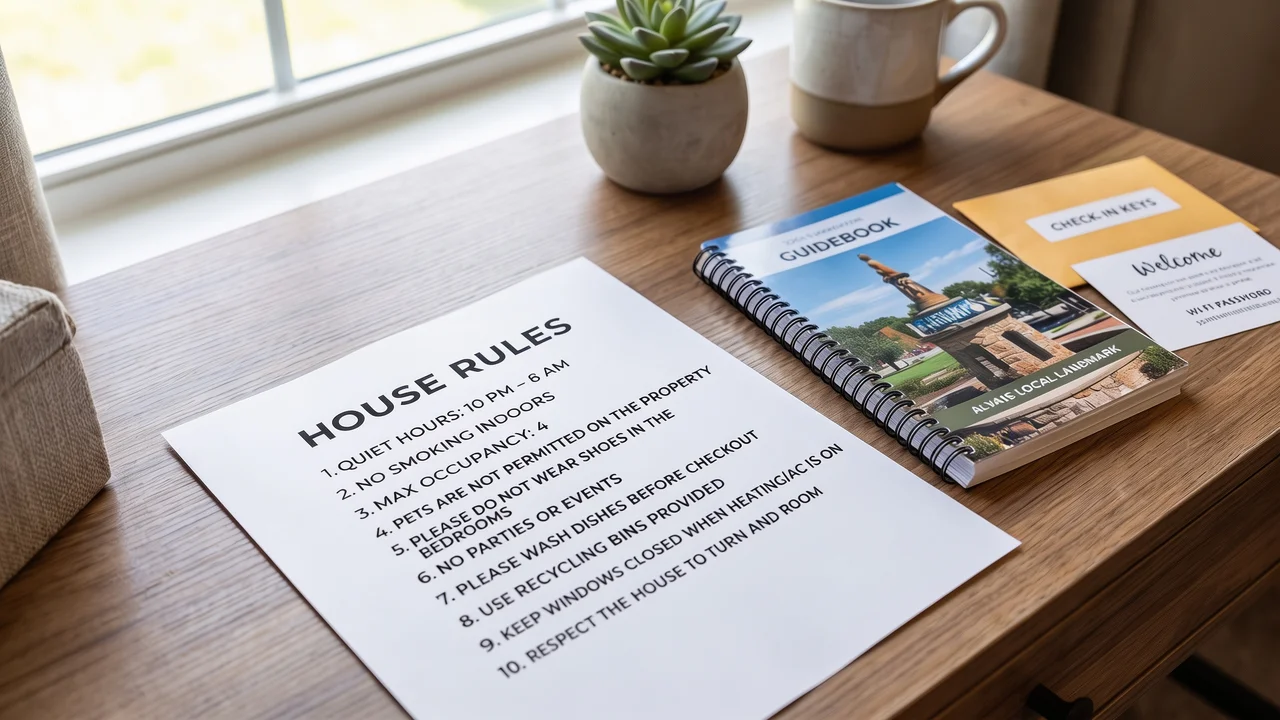
Every solid house rules list covers the same core categories, but the details you specify inside each one are what actually make them enforceable.
1. Maximum Occupancy and Unauthorized Guests
State the exact number of guests permitted, not just “family-sized” or “small groups.” Specify whether day visitors are allowed, and if so, whether they count toward the cap or need prior approval.
This gives you a concrete, enforceable line: if a booking says four guests and eight people show up, you have documented grounds to intervene, charge a fee, or end the stay early.
2. Quiet Hours and Noise Restrictions
Set explicit time windows, for example, “quiet hours 10 PM–8 AM” rather than “be respectful of neighbors.” Vague noise language is nearly impossible to enforce after the fact.
Specific hours protect your relationship with neighbors, reduce the risk of noise-ordinance complaints or fines, and give you a factual basis to address violations rather than a subjective judgment call.
3. Smoking and Vaping Policy
Clearly state that smoking and vaping are prohibited indoors, and identify any designated outdoor area if one exists. Note that violations result in a specific cleaning fee.
Smoke damage to furniture, carpets, and air quality is expensive and hard to reverse; an explicit policy with a stated fee gives you real recourse and a clear path to recover costs for property damage.
4. Pet Policy
Specify whether pets are allowed at all, and if so, any size, breed, or number limits, plus cleanup expectations and associated pet fees.
If your listing is pet-free, state that clearly rather than leaving it implied; undisclosed allergies or damage claims often trace back to this exact ambiguity. Pet-friendly listings should still define fees upfront to avoid billing disputes later.
5. Parties and Events
Explicitly prohibit parties and large gatherings, and clarify the exception: small family visits or quiet get-togethers within the occupancy cap are different from organized events.
Without this distinction, guests may reasonably assume a birthday dinner violates the same rule as a 30-person party, causing unnecessary friction, or worse, hosts miss genuine violations because the rule was never defined.
6. Check-in and Check-out Times
State exact times (e.g., check-in 3 PM, check-out 11 AM) rather than general windows, and understand what your options are with guests who overstay their checkout before it disrupts your next booking.
Exact times protect your cleaning and turnover schedule between guests.
7. Property Logistics (Parking, Trash, WiFi, Emergency Info)
Provide parking instructions, trash/recycling pickup days, WiFi network and password, and emergency contact information.
These aren’t behavior rules, but they prevent the majority of routine guest questions and support messages, and they make guests feel oriented and cared for from the moment they arrive.
How to Write and Communicate House Rules
Start with a short, friendly opening statement before diving into the list, something like “We want you to feel at home!
A few guidelines help keep things running smoothly for everyone.” This sets a welcoming tone so the rules that follow read as care, not control.
The rules themselves should be direct, not polite suggestions. This isn’t just style, it’s a compliance mechanism.
Vague, softened language gives guests room to interpret rules in their own favor, while specific, unambiguous phrasing removes that gray area entirely.
Before: “Please try to keep noise to a minimum in the evenings.” After: “Quiet hours are 10 PM–8 AM. Please keep noise at a minimum during this time.”
The second version leaves no room for “I didn’t realize it was too loud”; it states a measurable standard, which is what guests actually follow and what you can enforce if needed.
Display your rules in the listing description itself (so guests agree before booking), repeat key points in your pre-arrival message, include full details in your guidebook, and reinforce time-sensitive items like check-in/checkout in your check-in instructions.
How to Enforce House Rules When They’re Broken
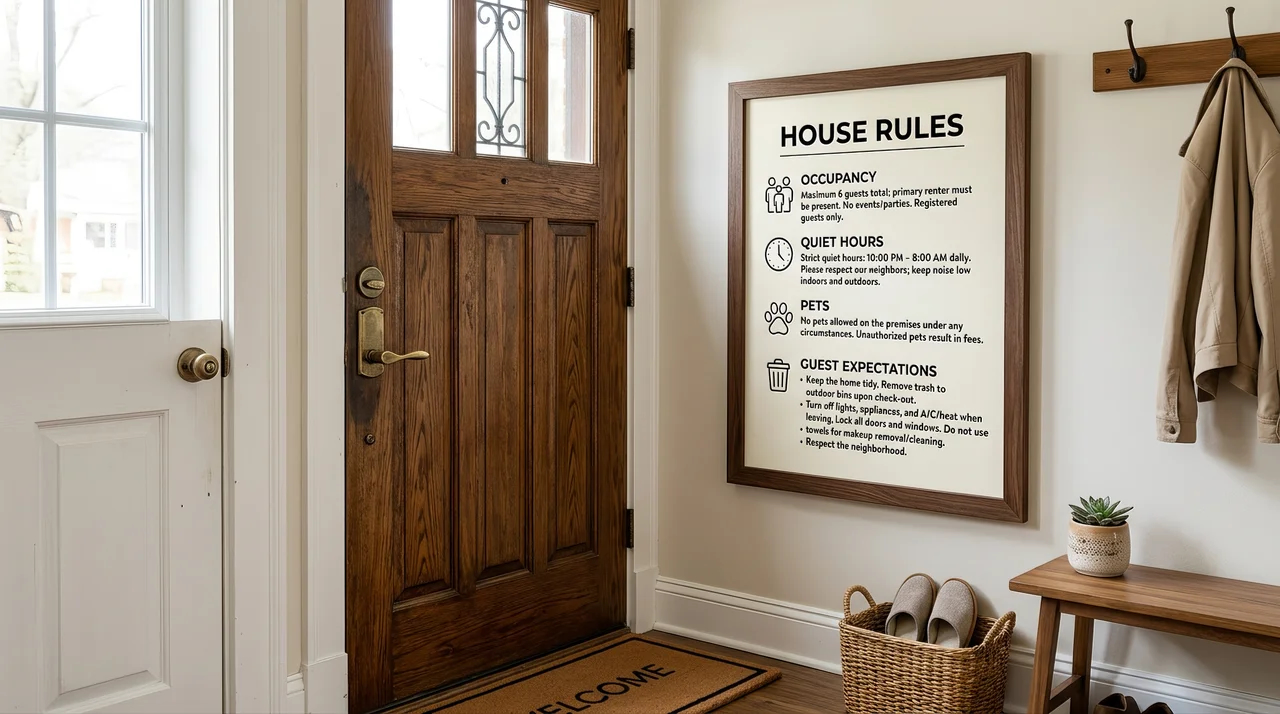
Rules only work if guests believe they’ll be enforced. A policy that exists but is never acted on trains guests, and future guests who read reviews, to ignore it.
- State consequences before check-in, not after a violation. List fees and actions directly in the house rules and booking confirmation (e.g., “Smoking indoors: $250 cleaning fee, charged to card on file”). This prevents the “no one told me” dispute that platforms often side with guests on.
- Set fee structures with specific dollar amounts, not vague language. “Additional cleaning may apply” invites pushback; “$150 flat fee for extra trash removal” doesn’t. Specific numbers hold up if a guest disputes the charge through Airbnb or their card issuer.
- Define what triggers cancellation: unauthorized guests over the limit, parties, safety issues, and say so explicitly; if a guest refuses to go, understand your options for removing a guest who won’t leave.
- Address it directly and promptly, not passive-aggressively in a review. Message the guest in-app (creating a record), state the specific rule broken, reference the agreed policy, and state the fee or next step. Calm and factual outperforms angry; it protects your Superhost status and holds up better in a platform dispute.
House Rules vs. Local Short-Term Rental Laws
House rules and short-term rental (STR) laws are not the same thing, and conflating them is a common source of confusion for both hosts and guests.
House rules are a private agreement, a host’s own preferences for how their property is used.
Local STR regulations are legal requirements set by a city, county, or state, and they exist independently of anything written in a listing.
This matters in both directions. A host can’t override a local ordinance by simply not mentioning it; occupancy caps, permit requirements, and registration rules apply whether or not they appear in the house rules.
Conversely, A host’s personal rule has no legal weight beyond the rental agreement itself; violating it isn’t illegal, it’s a breach of contract with the host.
Jurisdictions vary widely on specifics; some cap the number of unrelated occupants, some limit total rental days per year for non-owner-occupied units, and some require permits or add lodging taxes.
Because these figures change frequently and differ by city, hosts should verify current local requirements directly with their municipality rather than relying on generic guidance, and should state clearly in their listing that house rules operate alongside, not instead of, applicable law.
Setting Your Guests Up for a Good Stay
- Core message: Clarity, not control; house rules should read as setting expectations for a good stay, not policing guest behavior.
- Repeat the disputes-prevention thread: most conflicts happen because expectations weren’t clear upfront, not because guests are inherently difficult.
- Reinforce “early and often”: rules shared at booking, in check-in instructions, and posted in the unit, not sprung on someone mid-stay.
- Close on tone: end warm. This is the last thing the reader sees, so it should leave a “we want you to have a great time here” impression rather than a legalistic one, bookend against the opening section without repeating its phrasing.
- Suggested close idea (not full copy): a line about rules being the framework that lets hosts relax and guests enjoy the space, since everyone knows where the lines are.
Final Thoughts
Short-term rental house rules aren’t about controlling your guests. They’re about making sure everyone knows what to expect before problems start.
When your rules are clear and easy to find, most guests just follow them without a fight. The ones who don’t give you something solid to point back to.
I’d start by picking three rules your listing is missing and adding them today. Once you’ve done that, check out our guide on writing a welcome message guests actually read.
Frequently Asked Questions
Can a host remove a guest immediately for breaking a house rule?
Only for serious violations like safety threats or illegal activity. Minor issues typically require a warning first, and platforms often require documented communication before cancellation.
Is a security deposit the same as a house rules violation fee?
No. A security deposit covers damage and is often refundable; violation fees are separate charges for breaking specific stated rules, like smoking or exceeding occupancy limits.
Do house rules apply to service animals despite a no-pets policy?
No. Service animals are legally protected and exempt from pet restrictions in most jurisdictions, though hosts can still enforce behavior and cleanliness expectations.
Can a host change house rules after a guest has already booked?
Generally no, not for that reservation. Changed rules should apply to future bookings only; guests are bound by the rules displayed when they booked.
What happens if a guest ignores house rules and refuses to pay fees?
Hosts can file a resolution request through the platform, report the violation, and, in serious cases, file a claim through host protection or insurance coverage.