

Having your name on the deed feels like solid proof of ownership. But does it always mean you fully own the property? Not always, and many people find this out the hard way.
Property ownership involves more than just a name on a document. There are different deed types, ownership structures, and legal situations where being on the deed does not give you complete control.
Understanding what a deed actually gives you can save you from costly mistakes.
This guide covers everything you need to know about whether having your name on the deed means you own the property, including your rights, limitations, and what to watch out for.
Does Having Your Name on the Deed Mean You Own the Property?

Your name on the deed is a strong sign of ownership, but it is not always the whole picture.
A deed is a legal document that transfers property from one person to another. When your name appears on it, you have a recorded claim to that property. But ownership also depends on how the deed is written, what type of deed it is, and whether any other legal arrangements exist.
For example, you could be listed on a deed but only own a partial share. Or a lien or court judgment could limit your ability to sell or transfer the property freely.
In some cases, a spouse or co-owner may have rights to the property even if their name is not on the deed.
So yes, being on the deed matters. It is one of the clearest signs of legal ownership. But it does not automatically mean you have full, unrestricted rights to the property.
Deed vs. Title: Understanding the Difference
These two terms often get used together, but they mean different things.
| Feature | Deed | Title |
| What it is | A physical legal document | A legal concept of ownership rights |
| What it does | Transfers ownership from one party to another | Represents who holds rights to the property |
| Is it a document? | Yes, signed and recorded | No, it is a legal status, not a paper |
| Who holds it? | The new owner after transfer | The person or entity with legal ownership |
| Can it have issues? | Yes, forged, outdated, or incorrect deeds exist | Yes, clouded title from liens, disputes, or errors |
| Recorded publicly? | Yes, at the county recorder's office | Not recorded, but reflected through deed history |
| Key risk | A deed can transfer rights without a clear title | A title with defects can limit your ownership |
Think of the deed as the action and the title as the result. A deed transfers the title, but if the title has problems, the transfer may not hold up legally.
What Rights Do You Have If Your Name Is on the Deed?

Being listed on a deed gives you specific legal rights tied to that property.
- The right to use the property: That means living on it, renting it out, or using it for business, depending on zoning rules. You can also sell your ownership share, though with co-owners, this can get complicated.
- The right to exclude others: If your name is on the deed, you generally have the legal standing to prevent unauthorized people from entering or using the property.
- The right to mortgage the property: In most cases, you can use your ownership share as collateral. Lenders will check the deed to confirm you have the right to borrow against it.
- The right to a share of income: If the property generates income, such as from rent, you are entitled to a share of that income based on your ownership percentage.
- The right to take legal action: Your name on the deed gives you standing to take legal action related to the property, such as suing someone for trespassing or disputing boundary lines.
When Being on the Deed Does Not Mean Full Ownership
Existing liens: If the property has an existing lien, such as unpaid taxes or a contractor's lien, your ability to sell freely is restricted. The lien must be cleared before a clean sale can happen.
Joint ownership: Each co-owner has rights too. You cannot simply sell the entire property without consent from the other owners, depending on how the ownership is structured.
Life estate deeds: In this setup, one person holds the right to live on and use the property during their lifetime. The other person, called the remainderman, is on the deed but cannot take full control until the life tenant passes away.
Trust arrangements: If a property is held in a trust, the trustee manages it, and the beneficiaries benefit from it, even if their name appears somewhere in the ownership records.
Court orders: Court orders can also restrict what a deed holder can do with the property. During divorce proceedings, for instance, a judge may freeze property transfers until the case is settled.
Different Types of Property Ownership and Their Impact

How you hold ownership affects everything from your rights to what happens when you die.
Sole Ownership
This is the most clear-cut form. One person owns the property outright, with no co-owners. They can sell, mortgage, rent, or transfer the property without needing anyone else's agreement.
When they pass away, the property goes through their estate and is distributed based on a will or state intestacy laws.
Joint Tenancy
Joint tenancy involves two or more people owning equal shares. The defining feature is the right of survivorship. If one owner dies, their share automatically passes to the surviving owners without going through probate.
All owners must agree to sell or transfer the property. If one person wants out, they may need to file a partition action in court.
Tenancy in Common
This type allows co-owners to hold unequal shares. One person could own 60% and another 40%. Each owner can sell or transfer their individual share without the other's consent.
When an owner dies, their share passes through their estate, not automatically to the other owners. This is common in investment properties or situations where family members inherit together.
Community Property (Where Applicable)
Nine U.S. states follow community property laws: Arizona, California, Idaho, Louisiana, Nevada, New Mexico, Texas, Washington, and Wisconsin.
In these states, property acquired during marriage is generally owned equally by both spouses, regardless of whose name is on the deed. A spouse may have legal rights to the property even without being listed on it.
This principle comes up again later in this guide, since it affects both non-deed ownership and how marriage and divorce change ownership over time.
Types of Property Deeds Explained
Not all deeds offer the same level of protection. The type of deed you receive matters.
Grant Deed
A grant deed confirms that the seller has not already sold the property to someone else and that there are no undisclosed liens from the seller's time of ownership.
It offers a mid-level protection. Commonly used in California and some other states.
Quitclaim Deed
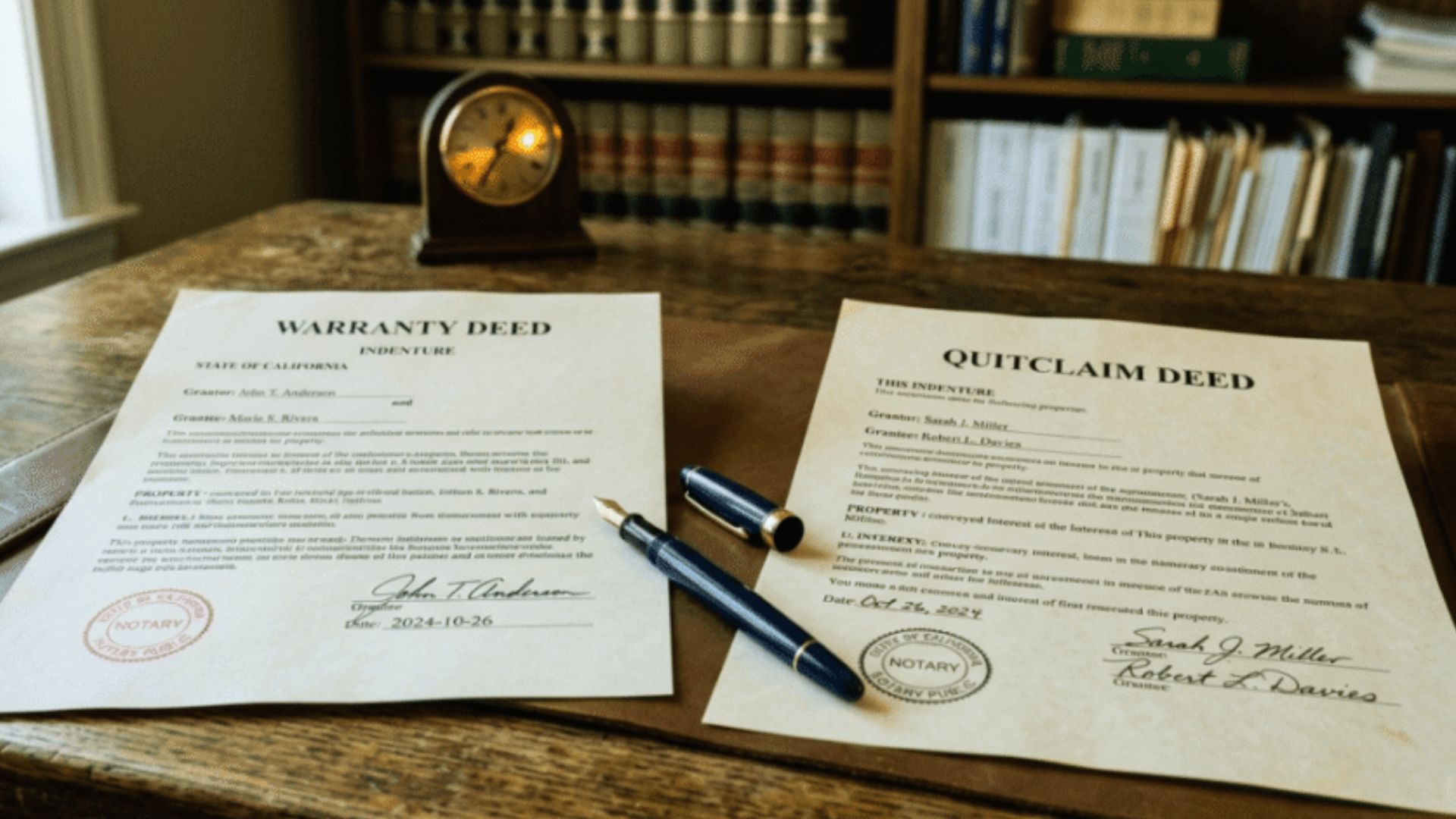
A quitclaim deed transfers whatever ownership interest the grantor has, with no guarantees. If the grantor has no valid interest, the grantee receives nothing.
These are often used between family members, in divorce settlements, or to clear up title issues. They are fast and simple but carry significant risk for the buyer.
Warranty Deed
A warranty deed offers the most protection. The seller guarantees that they have clear title, the right to sell the property, and will defend the buyer against any future claims to the title.
There are two types:general warranty deed, which covers the full history of the property, and special warranty deed, which only covers the period the seller owned it.
Which Deed type Offers the Most Protection?
A general warranty deed offers the strongest protection for a buyer. It holds the seller responsible for any title defects, even those that go back before they owned the property.
Always request a warranty deed when buying from a seller you do not know personally.
Grant Deed vs. Quitclaim Deed vs. Warranty Deed
See how a Grant Deed, Quitclaim Deed compares with Warranty Deed.
| Feature | Grant Deed | Quitclaim Deed | Warranty Deed |
| Guarantees clear title | Partial | No | Yes |
| Protects against past liens | Seller's period only | No | Yes (general) or seller's period (special) |
| Common use | California home sales | Family transfers, divorce | Standard real estate purchases |
| Buyer protection level | Moderate | Low | High |
| Used in competitive markets | Sometimes | Rarely | Most often |
| Risk to buyer | Medium | High | Low |
Name on the Deed but Not the Mortgage: What Happens?
This is more common than people think, and it creates a specific legal situation.
If your name is on the deed but not the mortgage, you have ownership rights but no loan obligation. You are not personally responsible for repaying the mortgage debt.
However, if the mortgage holder stops making payments, the lender can foreclose on the property, which would directly affect your ownership.
This often happens in cases where one spouse has better credit and takes out the mortgage alone, but both are listed on the deed. The co-owner benefits from the property but is not liable for the debt.
It can also happen when a parent gifts property to a child through a deed but keeps the mortgage in their name. The child owns the property on paper, but the mortgage must still be paid or the home can be lost to foreclosure.
If you are in this situation, it is wise to track mortgage payments and have a clear written agreement about who is responsible for what.
Name on the Mortgage but Not the Deed: What Are Your Rights?
Being on the mortgage but not the deed puts you in a tough spot legally.
You are financially responsible for the loan, but you have no legal ownership of the property. If payments are not made, your credit takes the hit. But you do not have the legal right to sell, transfer, or make ownership decisions about the property.
This situation sometimes arises when a lender requires a co-signer for the mortgage, but the co-signer is not added to the deed. It also happens when paperwork is completed incorrectly during a sale or refinance.
If you are paying a mortgage on a property you do not legally own, you should consult a real estate attorney immediately.
You may be able to have your name added to the deed, or you may need to negotiate with the other owner to protect your financial interest.
Can Someone Own Property Without Being on the Deed?
In certain situations, yes.
Under community property laws, a spouse may have an ownership interest in property even if their name is not on the deed. This is automatic in states that follow this system.
Adverse possession is another example. If someone openly, continuously, and exclusively uses a piece of land for a legally defined period, usually 5 to 20 years depending on the state, they may be able to claim legal ownership, even without a deed.
Equitable ownership can also arise in court. If someone has paid for a property but was never added to the deed due to a mistake or deception, a court may recognize them as an equitable owner.
Trust beneficiaries also hold a form of ownership interest, even though the trustee holds legal title.
How Marriage, Divorce, and Inheritance Affect Property Ownership
Life events can change who legally owns a property, sometimes without anyone filing new paperwork.
Getting married in a community property state can automatically extend certain rights to a spouse, as explained above. During a divorce, a court can order the transfer of property from one spouse to another. The outcome depends on whether the property is classified as marital or separate property and the laws of the state.
Inheritance brings its own complications. When a property owner dies, the property may transfer through a will, a trust, or state intestacy laws. If multiple heirs inherit together, they may end up as tenants in common, even if they never signed anything together.
If a deed is not updated after a death or divorce, the public record may still show the deceased or ex-spouse as an owner. This can create problems when you try to sell or refinance.
Common Ownership Disputes and How They Are Resolved
Disagreements over property ownership are more common than most people expect.
- Co-owner disputes: One frequent dispute involves co-owners who disagree on what to do with the property. One wants to sell, the other wants to keep it. When no agreement can be reached, a co-owner can file a partition lawsuit. A court then either orders the property sold and divides the proceeds, or physically divides the land if that is possible.
- Boundary disputes: These happen when neighbors disagree on where one property ends and another begins. They are often resolved through a land survey, and if necessary, a court ruling.
- Title disputes: These arise when two parties claim the same property, often due to errors in public records, forged deeds, or conflicting transfers. Title insurance can cover legal costs in these cases.
- Heir disputes: When a property owner dies without a clear will, family members may disagree on who inherits. The probate court handles these cases and distributes property based on state law.
Mediation is often faster and cheaper than going to court. Many real estate attorneys recommend trying mediation first before filing a lawsuit.
Common Mistakes Property Owners Should Avoid
Small errors in property ownership can lead to big legal and financial problems.
- Failing to update the deed after a life event: Marriage, divorce, or the death of a co-owner can leave outdated names on public records and complicate future transactions.
- Skipping title insurance when buying property: This leaves you exposed to claims, liens, or errors that may not surface until you try to sell.
- Adding someone to a deed without understanding the implications: This can trigger gift tax obligations or affect your ability to qualify for certain exemptions.
- Signing a quitclaim deed without fully understanding it: Not knowing what rights you are giving up or receiving can result in unintended ownership transfers.
- Not recording an updated deed: If it's not recorded with the county recorder's office, the change has no legal effect, even if both parties signed the document.
How to Verify You Legally Own a Property
If there is any question about your ownership, start with the public record.
- Check your county recorder's office: Visit in person or use their online portal to search for your property by address or parcel number. The most recently recorded deed should list the current legal owner.
- Order a title search: A licensed title company will trace the history of ownership and flag any liens, judgments, or gaps in the chain of title.
- Check for liens: Search local court records and the county tax assessor's database. Unpaid property taxes, contractor liens, or court judgments can all affect your ability to sell or borrow against the property.
- Consider purchasing title insurance: It protects you against claims or defects that were not discovered during the title search.
If anything looks incorrect or unclear, consult a real estate attorney before taking any action. Trying to fix title problems on your own can sometimes make them worse.
Expert Tips Before Buying, Selling, or Adding Someone to a Deed
A few careful steps before acting can prevent serious problems later.
- Always request a current title search before buying any property: Do this even from someone you trust, to confirm there are no liens, disputes, or ownership gaps.
- Work with a licensed real estate attorney when adding or removing someone from a deed: Errors in deed preparation can cloud your title and cause problems for years.
- Understand the ownership type before signing: Joint tenancy and tenancy in common have very different rules about what happens to the property when one owner dies.
- Confirm all co-owners are willing to sign when selling: A sale cannot legally close if one co-owner refuses, and you may need court intervention to move forward.
- Keep a certified copy of every deed: Store it along with the recording confirmation in a secure place. If disputes arise later, having documentation ready can resolve things much faster.
Conclusion
Understanding whether having your name on the deed means you own the property is not always simple, but it is important.
Your name on a deed is a strong sign of ownership, but the full picture includes the type of deed, how ownership is structured, and any legal arrangements that may limit your rights.
The key takeaway is this: always know what kind of deed you hold, verify it through public records, and get legal advice before making any major changes.
Frequently Asked Questions
Can a deed be valid if it was never recorded?
A signed deed can be legally valid between the parties, but recording it protects your ownership against future claims from third parties.
What happens to a deed when the property owner dies?
The property transfers based on the deed type, a will, trust terms, or state intestacy laws. Joint tenancy passes automatically to survivors.
Can someone be removed from a deed without their consent?
Generally no. Removing someone from a deed without consent requires a court order or a voluntary legal transfer signed by all parties.