Choosing how your estate is distributed among your family members is one of the most important decisions you will make in your estate planning process, and the exact wording you use can significantly affect who ultimately receives your assets.
Two terms appear repeatedly in wills, trusts, and beneficiary forms: per stirpes and per capita.
They sound similar, but they work in very different ways and can lead to dramatically different outcomes for your loved ones depending on your family structure and personal wishes.
This article breaks down what each term means, how distribution works under each method, and the key differences between them.
By the end, you will have a clear understanding of both methods and the confidence to make an informed decision that reflects your true intentions.
What Do Per Stirpes and Per Capita Mean?

Two Latin terms, two very different outcomes for your heirs.
Per stirpes means "by the branch" or "by roots." If one of your children passes away before you, that child's share passes down to their own children or descendants.
Each family branch stays intact, no matter how many people are in it.
Per capita means “by the head.” Generally, this method divides property equally among the living beneficiaries within the beneficiary class or level specified in the estate document.
If a beneficiary dies before you, their share may instead be distributed among the surviving beneficiaries covered by the applicable provision.
Depending on the document’s wording and governing law.
The testator or grantor, meaning the person who writes the will or sets up the trust, chooses which method applies.
The difference matters most when someone in your family tree passes away before you do. Getting this wrong can lead to outcomes you never intended.
How Does Per Capita Distribution Work?

Every living beneficiary at the chosen level gets an equal slice.
What Happens When a Beneficiary Dies Before You?
Under a per capita provision, a beneficiary who dies before you generally does not have their share pass automatically to their descendants.
Instead, the deceased beneficiary’s share is distributed according to the terms of the provision and the surviving beneficiaries included in the beneficiary class.
As a result, grandchildren may receive nothing unless they are included under the applicable language.
Per Capita Example With Children and Grandchildren
Say you have three children and one has passed away, leaving two grandchildren behind.
Under the per capita provision described in this example, the estate would be divided between the two surviving children.
While the deceased child’s children would not receive that child’s share.
The grandchildren from your deceased child are left out unless you specifically name them as beneficiaries.
How Does Per Stirpes Distribution Work?
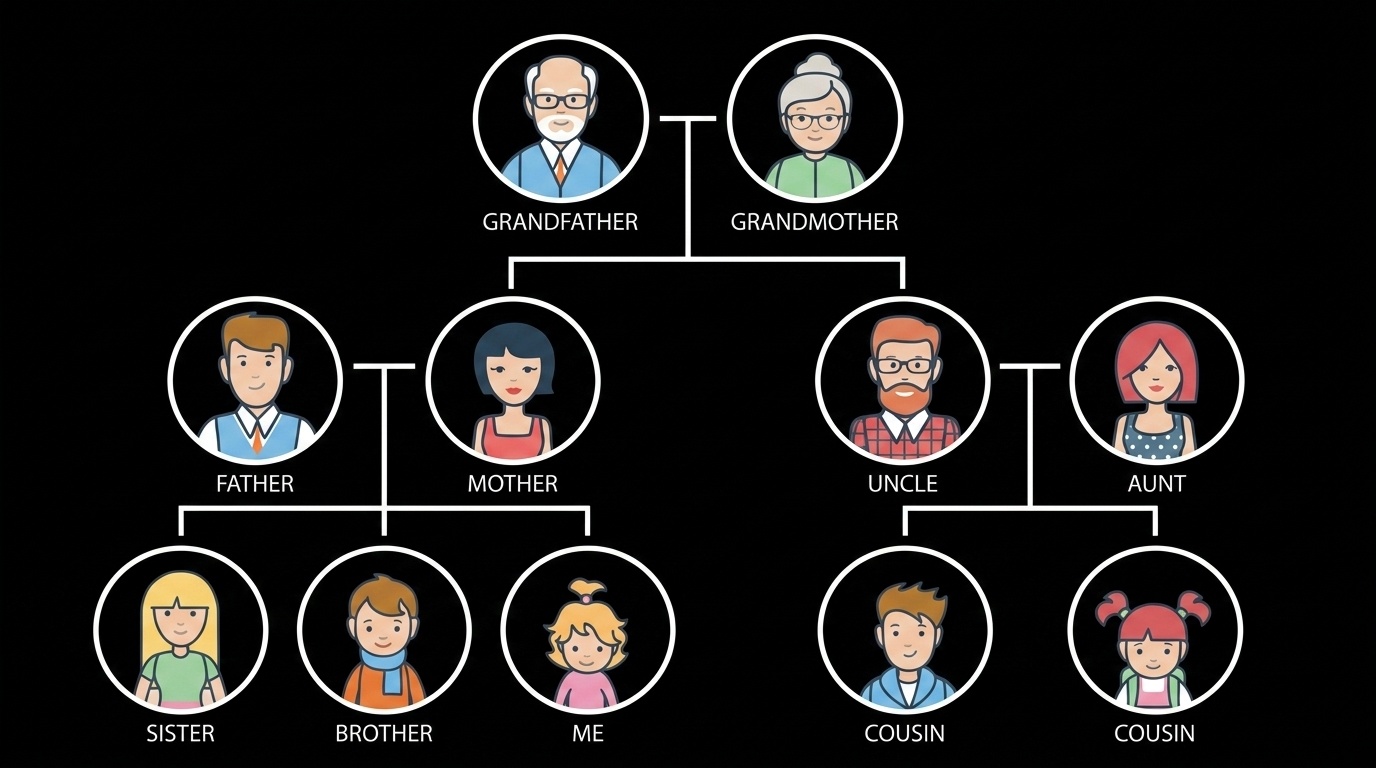
Family branches keep their share even after a loss.
What Happens to a Deceased Beneficiary's Share?
Under a per stirpes provision, if a named beneficiary dies before you, their share generally passes to their descendants according to the terms of the provision.
The family branch keeps its portion, split among the next generation in that line.
Per Stirpes Example With Children and Grandchildren
Consider the same three-children scenario: one child has passed away, leaving two grandchildren.
Under per stirpes, your estate is still divided into three equal shares.
The deceased child's share is then split between their two kids, meaning each grandchild receives one-sixth of the total estate. The surviving children each still receive their full one-third.
How the Two Methods Compare

Same starting point, very different paths for your heirs.
| Factor | Per Stirpes | Per Capita |
| Deceased beneficiary's share | Generally passes to descendants under the applicable provision | Generally distributed according to the provision among the applicable surviving beneficiaries |
| Grandchildren's inclusion | May inherit through a deceased parent's branch | May inherit depending on the beneficiary class and wording |
| Family branch treatment | Preserves each beneficiary's family branch | Generally focuses on equal distribution among the applicable beneficiaries |
| Equal distribution basis | By family branch | By beneficiary or applicable class |
| May suit | Families wanting a deceased beneficiary's descendants to retain that share | Families wanting distribution based on surviving beneficiaries or another specified class |
The key difference is what happens to a deceased beneficiary’s share. Under per stirpes, that share generally follows the beneficiary’s family branch.
Under per capita, the distribution generally follows the surviving beneficiaries or beneficiary class specified in the provision.
Grandchildren may inherit under a per stirpes provision when their parent, the named beneficiary, dies before the estate owner.
Under a per capita provision, whether grandchildren inherit depends on the beneficiary class and exact wording. Families with multiple generations should review these provisions carefully.
Per stirpes treats each child's line as its own branch that keeps a fixed share of the estate.
Per capita generally focuses on equal distribution among the applicable beneficiaries rather than preserving individual family branches.
This changes how much each grandchild might receive depending on family size.
Per Stirpes vs Per Capita: Which Is Better?

The better choice depends entirely on how your family is structured.
| Family Situation | Better Method | Reason |
| You want a deceased beneficiary’s descendants to retain that beneficiary’s intended share | Per Stirpes | The provision can preserve that family branch if the beneficiary dies before you |
| You want a simple equal split among living heirs | Per Capita | Every surviving beneficiary gets an equal share with no branch logic |
| You have a blended family with stepchildren | Per Stirpes | Keeps inheritance within each biological or legal branch |
| You have no grandchildren or a small simple family | Per Capita | Straightforward distribution with no branch complexity |
| Grandchildren vary greatly in number across branches | Per Stirpes | Prevents one branch from getting more simply due to having more children |
Per stirpes tends to work well for families who want to make sure grandchildren are provided for if a child passes away early.
It keeps things fair between family branches, even if one branch has more kids than another. Many parents choose this option to protect their grandchildren's inheritance.
Per capita may fit families who want a simple, equal split among whoever is living at the time of distribution.
It works well when you do not feel strongly about grandchildren inheriting through a parent's line. Some people prefer this for its straightforward structure.
Blended families may require especially careful drafting because the estate documents should clearly identify which children, stepchildren, descendants, or other relatives are intended to inherit.
Families without grandchildren, or with a simpler structure, may find per capita easier to work with. Your specific situation should guide the decision, not a general rule.
What Is Per Capita at Each Generation?
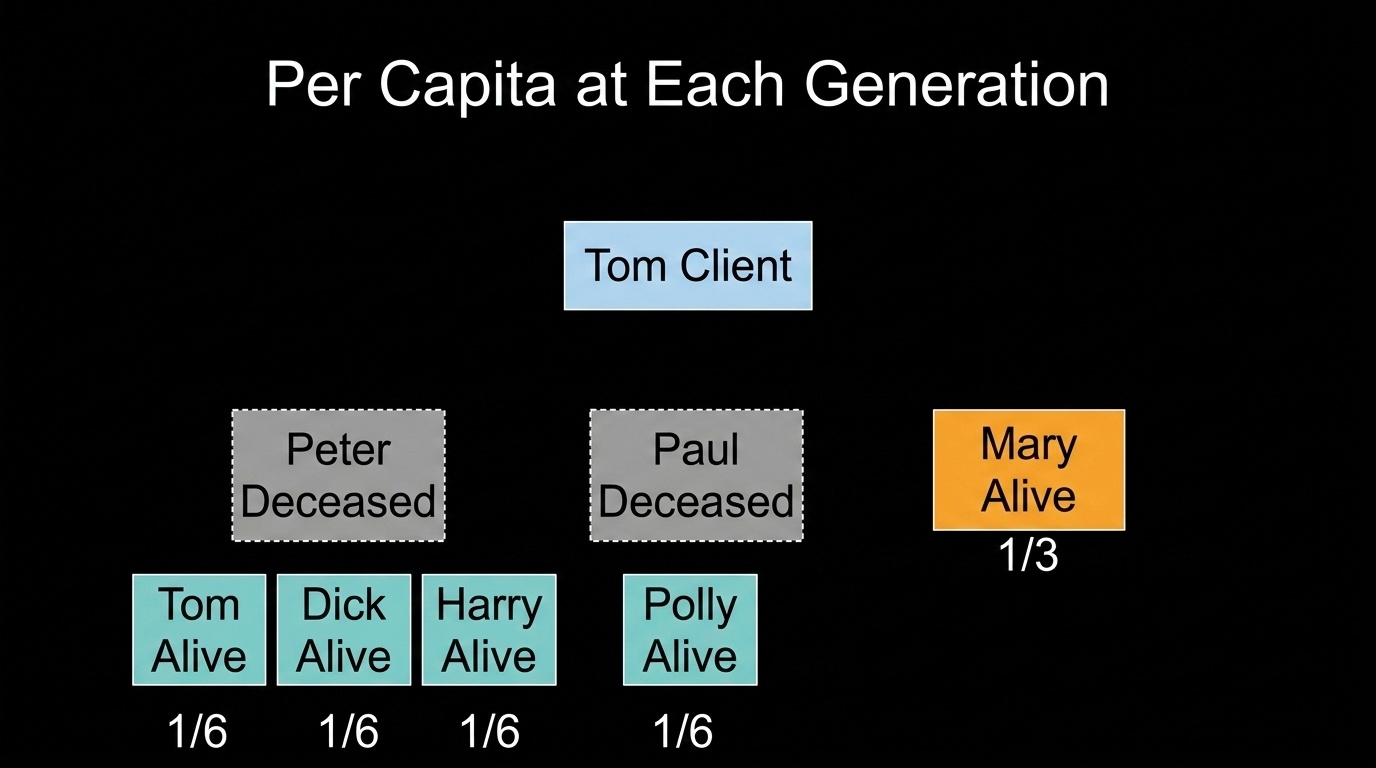
A third option that some states use as their legal default.
| Feature | Per Stirpes | Per Capita at Each Generation | Per Capita |
| Deceased beneficiary's share | Goes to their own descendants | Pooled and split equally across all descendants at the next level | Goes to surviving beneficiaries at the same level |
| Branch logic | Each branch splits its own share independently | Shares are pooled across branches at each generation | No branch logic applied |
| Result when two branches lose a beneficiary | Each branch handles its own split | All surviving grandchildren share equally regardless of branch | Surviving beneficiaries at the original level inherit more |
Some jurisdictions recognize per capita at each generation as a distribution method.
And applicable default rules may vary when estate documents do not specify how property should be distributed.
It works similarly to per stirpes in that descendants of a deceased beneficiary inherit their parent's share.
The key difference appears when multiple beneficiaries at the same generation have passed away.
Under per capita at each generation, the shares that would have gone to deceased beneficiaries at one level are pooled together.
Also will be divided equally among all surviving descendants at the next generation, regardless of which branch they come from.
This differs from strict per stirpes, where each branch independently splits only its own share. It is worth confirming which method your state defaults to before finalising your documents.
Per Stirpes vs Per Capita for Retirement Accounts

Beneficiary designation forms control more than most people realise.
| Distribution Method | If a Beneficiary Dies Before You | Potential Result |
| Per Capita | The deceased beneficiary's share is distributed according to the applicable provision | Surviving beneficiaries may receive the share |
| Per Stirpes | The deceased beneficiary's share generally follows their family branch | Their descendants may receive the share |
| Either method, beneficiary survives | The named beneficiary receives their designated share | Distribution follows the beneficiary designation |
Why Beneficiary Designations Matter
Retirement accounts such as 401(k)s and IRAs, as well as life insurance policies, generally pass according to the beneficiary designation on file rather than the instructions in your will.
If that form allows a per stirpes or per capita choice, it directly controls who receives the funds. Many people forget to update these forms, which can undo their estate planning goals.
How Distribution Choices Can Affect Inheritance
If a beneficiary dies before you, the distribution of their share depends on the designation available through the account provider and the terms you selected.
If you want a deceased beneficiary’s descendants to receive that share, confirm that the available designation supports that goal.
Choosing per stirpes on these forms, where available, protects that family branch. Always check what your account provider allows before assuming.
When to Review Your Retirement Account Beneficiaries
You should review your beneficiary designations after a birth, death, marriage, or divorce in the family.
Account providers do not automatically update these forms for you, so a periodic review keeps your accounts aligned with your actual wishes.
Tips for Choosing Between Per Stirpes and Per Capita
A few practical steps to help you land on the right choice.
- Review how your estate would be divided under both methods before making a final decision.
- Consider your children and grandchildren and how each option would affect them individually.
- Check your beneficiary designations on retirement accounts and life insurance, since they may not automatically match your will or trust.
- Think carefully about blended family situations, since stepchildren and half-siblings may or may not fall within a branch depending on how your documents are written.
- Discuss your choice with an estate planning attorney who can walk you through your specific family situation.
Common Mistakes With Per Stirpes and Per Capita
Small oversights here can lead to big headaches for your family.
- Failing to clearly specify how your assets should be distributed, which can leave the result dependent on the terms of your documents and applicable state law.
- Assuming a will controls every beneficiary designation, when retirement accounts and life insurance often follow separate forms.
- Not updating beneficiaries after family changes, such as a new grandchild or the loss of a family member.
- Mixing up the two terms when filling out legal or financial paperwork, leading to unintended results.
- Skipping professional guidance, which can result in language that does not hold up the way you expected and, in some cases, lead to probate disputes.
Conclusion
Choosing between per stirpes and per capita is not just legal paperwork. It is a decision about making sure the people you love are cared for exactly the way you actually want.
Take a moment to picture how your own estate would play out under each method and consider how your specific family structure tips the decision in one direction or the other.
Small wording differences in a will or trust can lead to very different outcomes. If this helped clear things up, share it with someone who is working through their own estate plan.
Frequently Asked Questions
Can I mix per stirpes and per capita in one estate plan?
Yes, some people use per stirpes for one part of their estate and per capita for another. This usually depends on how their will or trust is written.
Does per stirpes always include grandchildren?
Grandchildren may inherit under a per stirpes provision when their parent, the named beneficiary, dies before the estate owner.
The exact result depends on the wording of the estate document and applicable law. If their parent is still living, the grandchildren typically do not receive a direct share.
Which method is more common in wills?
There is no single method that is right for every will.
Per stirpes may be appropriate when the goal is to preserve a deceased beneficiary’s share for their descendants, while per capita may suit different family or distribution goals.
Can I change my distribution method later?
You may be able to update your will, trust, or beneficiary designations while you are alive and legally able to make changes. The process depends on the document or account involved.
Do state laws affect per stirpes and per capita rules?
Yes, some states have their own default rules if your documents do not specify a method, and some use a variation called per capita at each generation. It is worth checking your state's laws or asking a professional for guidance.