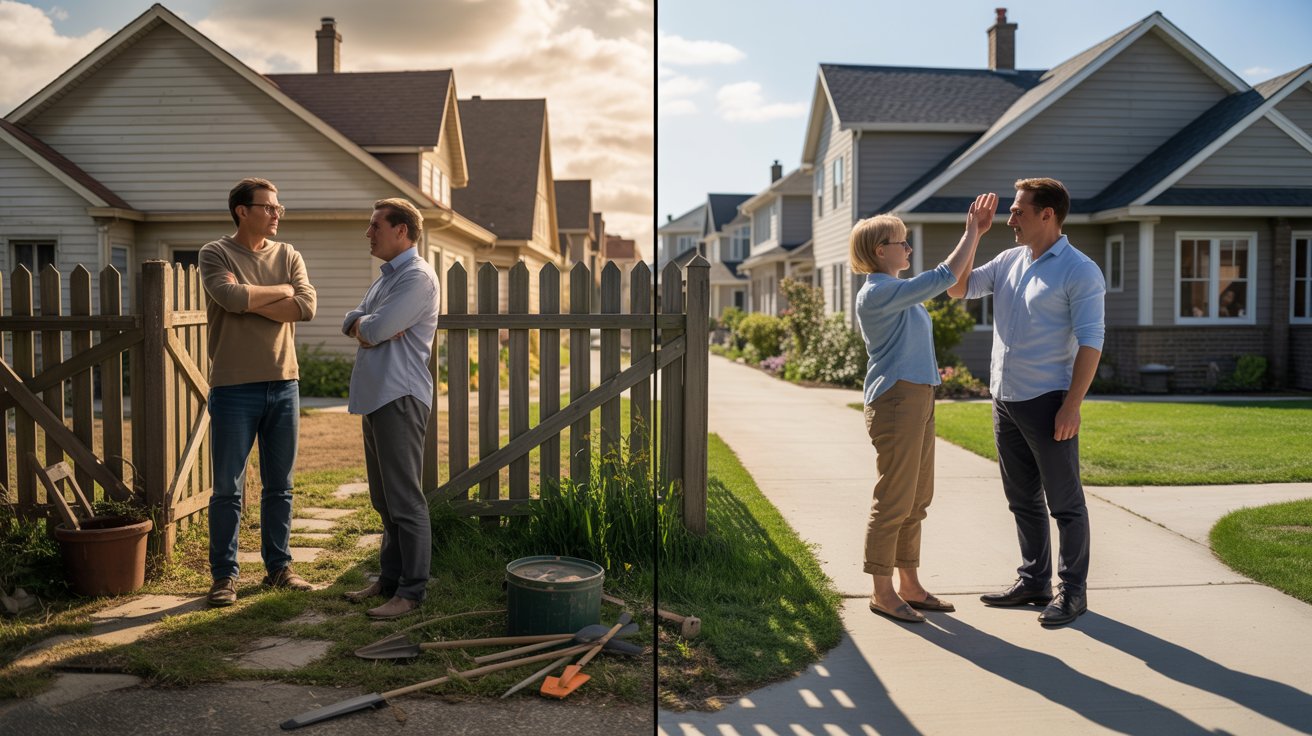
Property line disputes can turn a good-neighbour relationship into a costly, drawn-out conflict. If you are unsure where your property ends and your neighbour's begins, you are not alone.
Boundary disagreements affect owners in new suburbs and established areas equally, and they rarely resolve on their own without the right approach.
The first step is confirming your legal boundary using your deed, plat, or a licensed surveyor.
Acting early gives you more options and costs far less than waiting until the problem becomes a formal legal matter.
This article explains how boundaries are set, what causes disputes, and how to resolve them with or without going to court.
What Property Line Disputes Are and Why They Happen

Property line disputes occur when neighbours disagree about where one property ends and another begins.
The conflict can involve fences, buildings, trees, or shared access paths. These disputes are more common than most people expect, and they affect owners in new suburbs just as much as those in established areas.
Most disputes begin because of unclear records, outdated surveys, or physical markers that have shifted over time. A fence may have been placed slightly off the legal line decades ago.
A new owner may skip checking the boundary documents before building a shed or planting a hedge.
Misunderstandings between neighbours make things worse, since many people assume the boundary sits where they think it does rather than where the legal documents confirm.
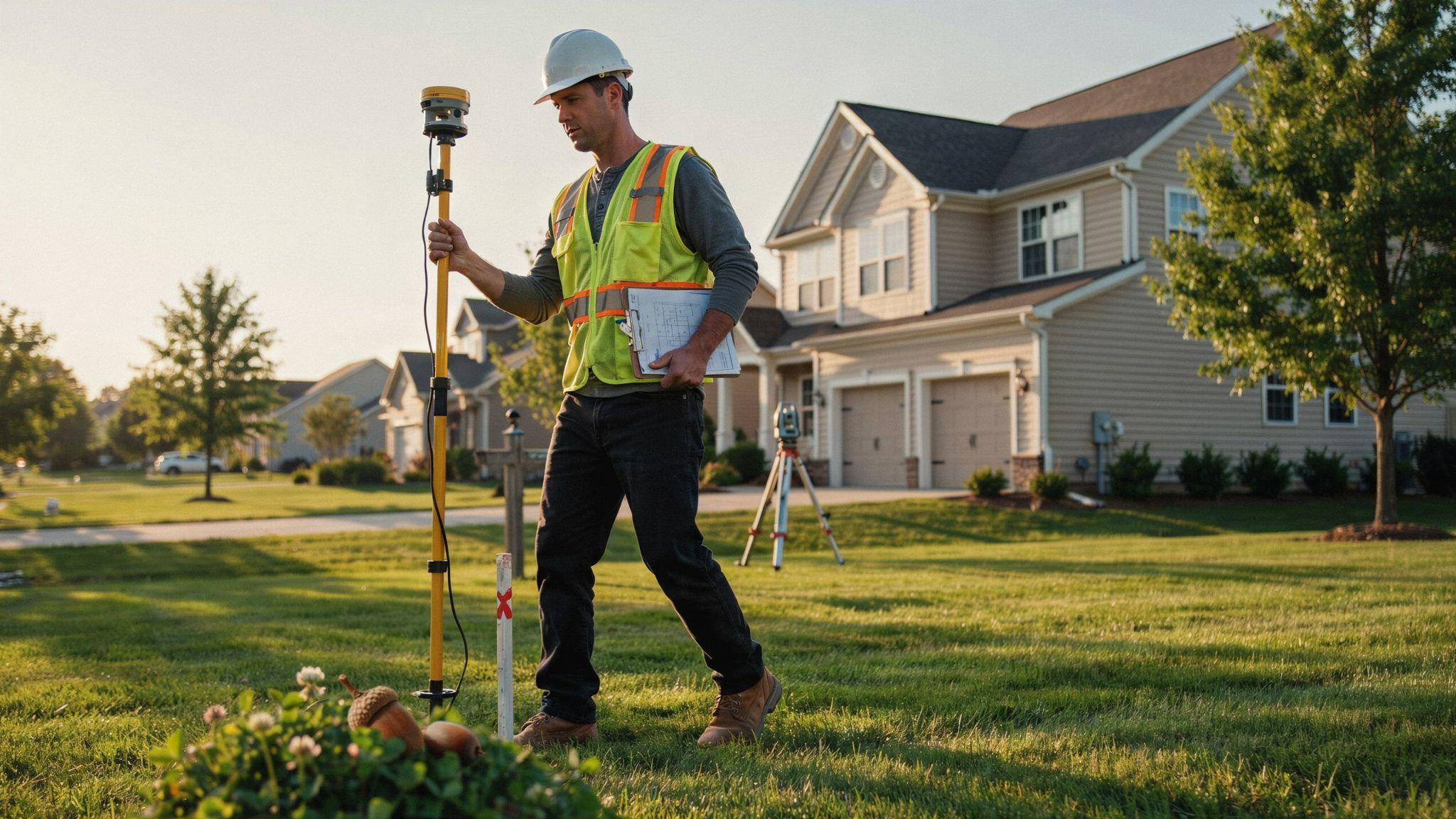
The legal responsibility for confirming boundaries falls on each property owner. Hiring a licensed land surveyor is the most reliable way to establish the correct line and verify what the records show.
Acting before a misunderstanding becomes a formal dispute is almost always faster and cheaper than resolving it afterwards.
How to Understand Your Property Boundary
Understanding boundary documents helps you avoid the mistakes that lead to disputes. Here is what each record contains and why physical markers can mislead you.
How Surveyors Establish Property Lines
Property lines are set through a combination of legal documents and physical measurements. When land is first divided or sold, a licensed land surveyor measures the exact dimensions and records them in the official register.
These measurements are tied to fixed reference points such as roads, survey pegs, or permanent markers so the boundary can be retraced accurately in the future.
Over time, errors can appear in the record. Older surveys used less precise equipment, and natural features used as reference points such as trees or creek banks change or disappear.
Recorded descriptions do not always match what is physically on the ground, and those gaps between the paper record and reality are often what triggers a formal dispute.
What Deeds, Plats, and Surveys Each Tell You
Three documents define your property boundary, and each serves a different purpose. Reviewing all three before buying or building is the most effective way to avoid problems.
Deeds record legal ownership and usually contain a written boundary description. Older deeds can use vague language like "to the old oak tree," which creates problems when that reference no longer exists.
Plats are maps created when a subdivision is laid out, showing how land is divided relative to roads and neighbouring parcels. Most councils hold plats on record and can provide copies on request.
A current survey document differs from both: it's a certified, on-the-ground measurement rather than a written description or a subdivision map. It shows the exact boundary as it exists today, marked with coordinates and reference points a surveyor has personally verified, which is why it carries the most legal weight of the three if a dispute ends up in mediation or court.
Why Physical Markers Can Mislead You
Fences, hedges, and retaining walls are frequently treated as property boundaries, but they are not always accurate.
A fence might have been placed slightly on the wrong side of the boundary years ago, and that mistake becomes assumed to be correct over generations of ownership.
Most people inherit the fence and never check whether it matches the survey.
The same problem applies to natural markers such as trees or overgrown hedges. They grow, spread, and shift over time.
What you see on the ground and what the survey shows can differ by several metres, which is why you should always verify official documents before treating any physical feature as the true legal boundary.
How Easements Affect What You Can Do With Your Land
An easement gives someone the legal right to use part of your property for a specific purpose, even though you own the land.
Common examples include utility companies accessing power infrastructure or a neighbour using a registered path across your land to reach a public road.
Easements do not change ownership, but they do restrict how you use your land. If you build over a registered easement, you may be required to remove the structure at your own cost.
Always check for easements before starting any construction or landscaping project near your boundary, as overlooking one can lead to expensive consequences.
The Most Common Property Line Disputes Homeowners Face

Knowing the most common dispute types helps you identify problems early and take the right action before things escalate.
Fence and Boundary Structure Disagreements
Fence disputes are among the most frequent boundary conflicts between neighbours. They arise when a fence is built on the wrong side of the legal line, when a neighbour replaces an old fence in a slightly different location, or when there is disagreement about who is responsible for repairs and costs.
Both parties often assume the original fence was correct, which is where the conflict begins. Even a fence positioned only a few inches over the boundary creates a legal problem.
Over many years, a misplaced fence can give the encroaching party a legal claim to that strip of land through adverse possession, a rule that allows someone to claim ownership of land they have openly occupied without challenge for a legally defined period.
That period varies by jurisdiction, so check the laws that apply to your state or territory specifically.
Encroachment by Structures and Outdoor Buildings
Encroachment happens when a structure such as a garage, shed, deck, or home addition crosses over a property line onto a neighbour's land. This is a serious issue because relocating or removing a structure is expensive, disruptive, and time-consuming.
Even small encroachments can become major legal and financial problems when left unaddressed for years.
Before building anything near your boundary, confirm the exact line with a current survey.
If a neighbouring structure is encroaching on your land, address it as soon as you become aware of it. Waiting makes resolution harder and can weaken your legal position, particularly once adverse possession periods have begun to run under your local laws.
Trees, Roots, and Overhanging Branches
Trees growing near or on a property boundary are a consistent source of conflict between neighbours. If a tree sits directly on the boundary, both owners may share legal responsibility for it.
If branches overhang your land, you generally have the right to trim them back to the property line, though the specific rules vary by state and local council.
Root damage is a separate issue that often escalates without early warning. Tree roots can crack driveways, lift footpaths, damage building foundations, and disturb underground pipes.
If a neighbour's tree is causing measurable damage to your property, you may have legal recourse. Raise the issue with your neighbour before escalating. Most tree disputes settle without court involvement when communication stays open and the evidence is clear.
Shared Driveways and Access Disputes
A shared driveway sits on or near a property line and is used by two or more owners.
These arrangements often function without incident for many years until one owner decides to block access, alter the surface, or build something that limits use by the other party. Without a written agreement, resolving the dispute becomes far more difficult.
Shared driveway agreements should always be formalised in writing and registered on both property titles.
If yours is not documented, put a formal written agreement in place before a problem develops. An unregistered verbal arrangement carries no legal weight when a property changes hands and the new owner disputes the access rights.
Boundary Problems That Surface During a Sale
Buying or selling a property can expose boundary issues that previous owners never addressed. A new buyer may discover that a fence, garden bed, or outbuilding does not match the legal survey line.
A seller may have made statements about the boundary that turn out to be incorrect once the documents are properly examined.
These issues can delay or collapse a sale entirely. If you are buying, ask whether the property has title insurance, it may protect you if a boundary problem surfaces after settlement.
Title insurance covers losses arising from defects that existed before your purchase, including undisclosed boundary encroachments.
If you are selling, confirm that your boundary records are accurate and available to share with the buyer well before you list.
How to Resolve Property Line Disputes: Step by Step
Following a clear process gives you the best chance of a quick, cost-effective outcome. Skipping steps almost always makes things longer and more expensive.
1. Confirm the legal boundary with documents:
Before taking any action, confirm where your legal boundary sits. Obtain your deed, plat, and any existing survey from your council or title office.
Review each document carefully, paying attention to boundary descriptions and reference points. If the records are old, incomplete, or contradictory, hire a licensed land surveyor to physically mark the boundary on the ground.
A surveyor's confirmed boundary gives you something concrete to negotiate from, without it, any conversation with your neighbour or a lawyer rests on assumption rather than verified evidence, which weakens your position considerably.
If the documents you retrieve are more than ten years old, commission a new survey before proceeding, as older surveys may not reflect changes on the ground.
2. Approach your neighbour directly
Many property line disputes resolve with a calm, respectful conversation. Approach your neighbour with the documents rather than with frustration.
Present the evidence clearly, explain your concern, and ask for their response. You may find they were unaware of the issue or are willing to address it without the need for formal proceedings.
Keeping the conversation constructive matters well beyond the immediate dispute, you will continue to live next to this person after the issue is resolved.
A cooperative approach almost always costs less in time, money, and stress than escalating to lawyers or the courts at the outset.
3. Commission a licensed land surveyor
Engaging a licensed land surveyor is the right move if, no existing survey is available or the current one is outdated, your neighbour disputes the boundary even after you share your documents, you plan to build a fence, shed, driveway, or structure near the boundary, or you are buying or selling a property and need confirmed dimensions.
A surveyor's report carries legal weight and supports your position in mediation or court proceedings. It also removes the ambiguity that allows most boundary disputes to continue unresolved for years.
Survey costs are minor compared with the legal fees that accumulate when a dispute goes to litigation without a confirmed boundary on record.
4. Try mediation before going to court
Mediation involves a neutral third party who helps both sides reach an agreement without a formal court decision.
It is faster, cheaper, and far less adversarial than litigation. Many councils and community justice centres offer mediation services for neighbour disputes at little or no cost, contact yours before assuming legal action is the only path forward.
Court action should be a last resort. Proceedings take time, cost significant money, and can permanently damage the relationship with your neighbour.
If the dispute involves a major encroachment, measurable financial loss, or a neighbour who refuses any engagement, consult a property lawyer to understand your full range of options before committing to litigation.
What Documents and Evidence Strengthen Your Position
If your dispute moves to mediation or court, thorough documentation significantly strengthens your case.
Evidence gathered early, before either party makes changes to the disputed area, carries more weight than material collected after the dispute has escalated.
Gather the following before any formal process begins:
- Your deed and the boundary description it contains
- The most current property survey available
- Plat maps from your council or municipality
- Dated photographs of the disputed area, including structures, fences, and encroachments
- All written communication with your neighbour about the dispute
- Any prior written agreements about shared land, fences, or structures
Organise everything chronologically and keep both digital and physical copies in a secure location.
The earlier you documented the evidence, the stronger your position will be if the matter proceeds to a formal hearing.
Property Line Disputes Compared: Choosing the Right Response
Not every boundary problem calls for the same response. The table below helps you pick the right action and avoid wasting time on the wrong approach.
| Situation | What It Means | Recommended Action |
|---|---|---|
| Property line dispute vs. encroachment | A dispute is a disagreement about where the boundary sits. Encroachment is when a structure or landscaping physically crosses it. | Confirm the legal boundary with a current survey before addressing the physical encroachment. |
| Property line dispute vs. easement issue | A boundary dispute is about who owns the land. An easement issue involves the legal right to use another person's land without transferring ownership. | Review your deed, any easement documents, and title records to identify which legal right applies. |
| Survey vs. boundary agreement | A property survey is an official measurement by a licensed surveyor. A boundary agreement is a written arrangement between neighbours that establishes a mutually accepted line. | Use a survey when legal certainty is required. Use a boundary agreement when both parties are prepared to settle cooperatively. |
| Boundary by acquiescence | When both parties have treated a physical feature such as a fence or hedge as the boundary for many years, a court may recognise it as legally binding even if it differs from the survey. | Seek legal advice before challenging a long-standing boundary feature, as acquiescence may affect your claim. |
| Minor disagreement between neighbours | The issue is limited in scope and both owners are willing to communicate. | Start with a respectful conversation and review available property documents together before involving any third party. |
| Unclear or undocumented boundary | The exact boundary cannot be confirmed from existing markers or records. | Hire a licensed land surveyor to determine the legal property line with a current certified survey. |
| Neighbour refuses to engage | Direct discussions have failed or the other party will not respond to contact. | Pursue mediation through your local council or community justice centre before considering legal action. |
| Significant encroachment or financial impact | The dispute involves a major structure, measurable loss of land use, or clear legal liability. | Consult a property lawyer to understand your rights and the full range of options available to you. |
| Construction or landscaping planned near the line | You intend to install a fence, shed, driveway, or garden near the boundary. | Confirm the exact property line before any work begins to avoid creating a new dispute. |
Tips to Prevent Property Line Disputes Before They Start
Preventing a dispute costs far less than resolving one. These habits protect your property before conflict requires outside intervention.
- Check your boundary before construction or planting: Obtain your deed, plat, and a current survey before installing a fence, driveway, or structure near the property line. One placement error can take years and significant expense to fix once a structure is in place.
- Keep property documents accessible and backed up: Store digital and physical copies of your deed, survey, and plat in a secure location. Include them in handover documents when you sell, so new owners work from verified fact rather than assumption.
- Put any boundary agreement in writing and register it:A verbal agreement carries no legal weight if your neighbour sells. A written agreement registered on both titles protects both parties regardless of future ownership.
- Check for easements before buying or building:Your conveyancer should identify all registered easements during purchase. Removing a structure built over a registered easement can cost more than the structure itself.
- Act early when you spot a boundary problem: Adverse possession laws vary by jurisdiction but can allow someone occupying your land without challenge to acquire a legal right to it. Document any encroachment immediately and seek professional advice if it does not resolve quickly.
Conclusion
Most boundary issues resolve before escalating when you know your legal position and act on it early.
Confirm your boundary, keep your documents in order, and speak to your neighbour before involving lawyers or the courts.
If the dispute is serious, a licensed land surveyor or property lawyer provides the clearest path forward.
The steps in this article apply whether your boundary issue is just starting or has already become a complicated legal matter. Start with the documents, act on the evidence, and address problems as soon as they appear.
Frequently Asked Questions
Can a neighbour legally move a fence that has been in place for decades?
Not without clear evidence it was always incorrectly positioned. Long-standing fences may carry legal protection under adverse possession or boundary by acquiescence principles. Get a licensed surveyor to confirm the legal boundary first.
Does homeowner's insurance cover property line disputes?
Generally, no. Most standard policies exclude boundary dispute legal costs. Title insurance may help if the problem existed before your purchase. Check your policy and confirm with your insurer before assuming coverage.
How long does a property line dispute take to resolve?
A direct conversation may resolve things within days. Mediation typically concludes within weeks. Court proceedings can take one to three years or longer depending on complexity and jurisdiction.
Can I install a security camera near a disputed property line?
Yes, but it must not point into a neighbour's private spaces such as windows or backyards. Privacy laws vary by location, so check local regulations before installing any equipment near a disputed boundary.
What happens if I buy a home and later discover an encroachment?
You may have a claim against the seller or title insurer depending on what was disclosed before settlement. Consult a property lawyer to review your contract and insurance documentation before acting.
When should I contact a property lawyer about a boundary dispute?
Contact one when your neighbour refuses to engage, a significant structure is encroaching, or adverse possession may apply. Early advice costs far less than waiting until the dispute escalates.