

California courts split property the same way regardless of marriage length. Ten years of marriage does not change how a court divides your assets, it does change how the court handles spousal support.
California is a community property state, so most assets and debts from the marriage get divided equally under Family Code Section 2550, and this applies to a two-year marriage and a twenty-year marriage in the same way.
What shifts after a decade is the length and structure of spousal support, since courts treat marriages of ten years or more differently.
This guide explains california community property law 10 years, including how property, debt, and spousal support are handled after a decade of marriage.
What Counts as Community Property in California

Property and debt built during marriage usually belong to both spouses.
California treats most property acquired during marriage as jointly owned, regardless of whose name appears on the title or account.
Property owned before the wedding, along with gifts and inheritances received by one spouse, usually stays separate.
When a marriage ends, community property splits evenly under Family Code Section 2550. This rule holds true whether the couple was married for two years or twenty years.
Marriage length affects spousal support, not the property division rule itself.
How California Divides Property After 10 Years

The same equal-division rule applies no matter how long you were married.
The Equal Division Rule
California courts split community property fifty-fifty under Family Code Section 2550. This covers homes, savings, retirement accounts, and most debts from the marriage. The court does not weigh who earned more or contributed what; fair here means equal value, not equal items. One spouse might keep the house while the other receives cash or investments worth the same amount.
For example, if a couple's only major asset is a $600,000 house with no mortgage, one spouse might keep the house while the other receives $300,000 in cash or investments, or the couple sells it and splits the proceeds evenly.
Identifying Community Assets and Debts
Before any split happens, the court needs a full list of what counts as community property. This includes income, real estate, retirement accounts, and marital debts.
Both spouses file a Preliminary Declaration of Disclosure (PDOD), a sworn document listing all assets, debts, income, and expenses under penalty of perjury.
Missing or hidden assets can create serious legal trouble later in the case.
Valuing Property Before Division
Once assets are identified, they need a fair value attached.
Homes typically need appraisals, retirement accounts need current statements, and businesses often need a professional valuation, sometimes from a forensic accountant.
Accurate numbers matter because they decide how the overall split gets balanced between spouses.
Equalization Payments
Sometimes one spouse keeps an asset worth more than their fair share, like the family home.
To balance the split, that spouse pays the other spouse the difference in cash. This is called an equalization payment, and it keeps the overall division even.
Assets Most Often Divided in a Divorce
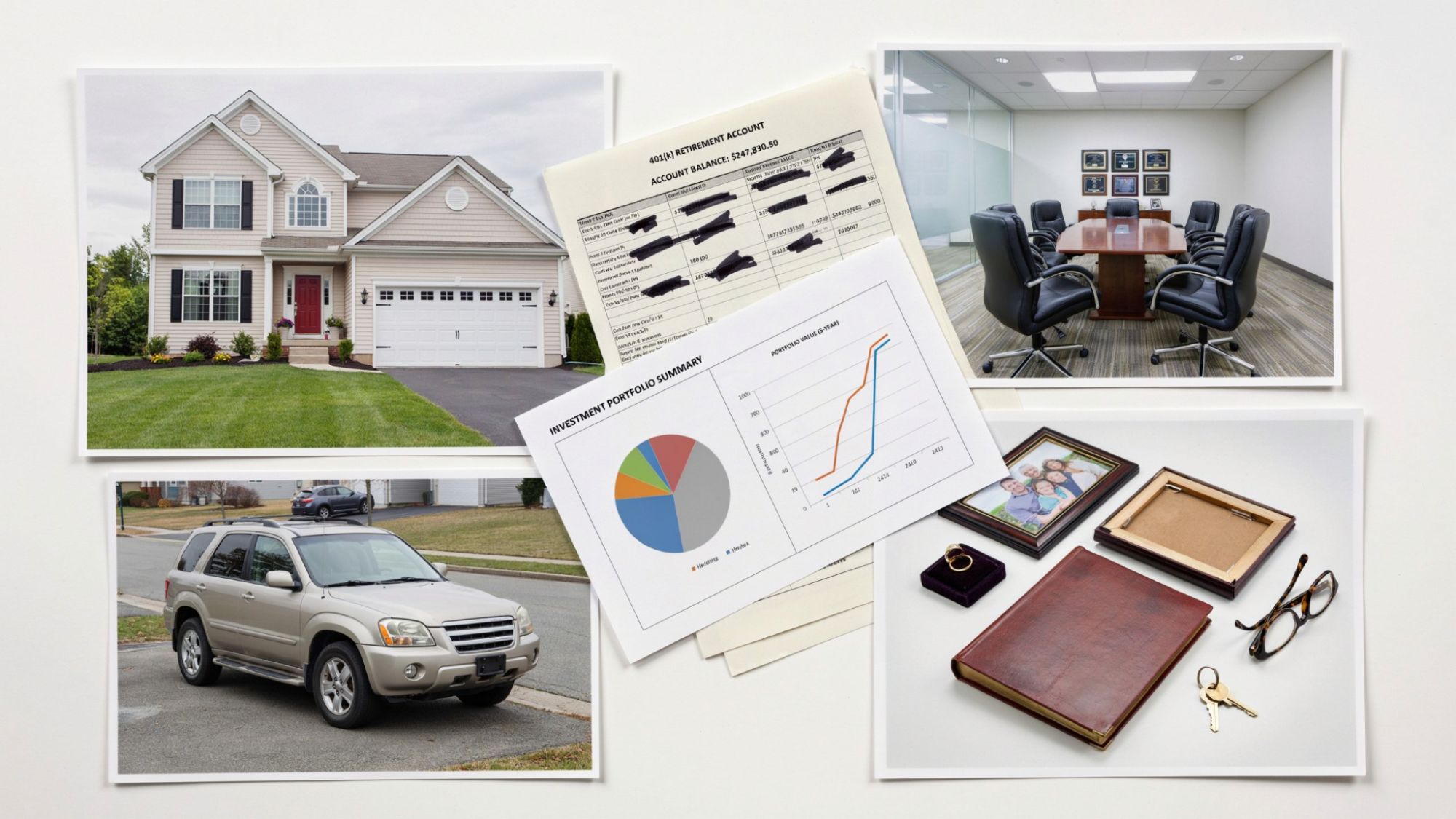
Homes, retirement funds, and businesses come up in nearly every case.
The Family Home
The family home is often the largest asset in a divorce. Its value on the date of separation usually sets the starting point for dividing it.
Couples can sell the home and split the proceeds, or one spouse can buy out the other's share and keep it.
Retirement Accounts and Pensions
The portion of retirement benefits earned during the marriage is generally community property. This includes 401(k)s, pensions, and IRAs.
A court order called a QDRO is often required to split these accounts correctly without triggering tax penalties.
Bank Accounts and Investments
Checking, savings, and investment accounts built during the marriage get split evenly.
Statements from the date of separation help determine what counts, since income earned after that date belongs to the person who earned it.
Businesses and Professional Practices
A business started or grown during the marriage may count as community property, even if only one spouse runs it.
These cases often need a professional valuation. Courts may also weigh the business's goodwill, the value tied to its name and reputation, separately from its physical assets.
Vehicles and Personal Property
Cars, furniture, and other personal items bought during the marriage typically count as community property.
Courts and attorneys often use Kelley Blue Book private party values to price vehicles fairly. Couples often divide these items by agreement instead of a court order.
Pets Under California Law
California law allows courts to treat pets differently from other property.
Under Family Code Section 2605, judges can consider a pet's well-being and daily care when deciding who keeps it, rather than simply splitting its value.
How California Divides Marital Debt
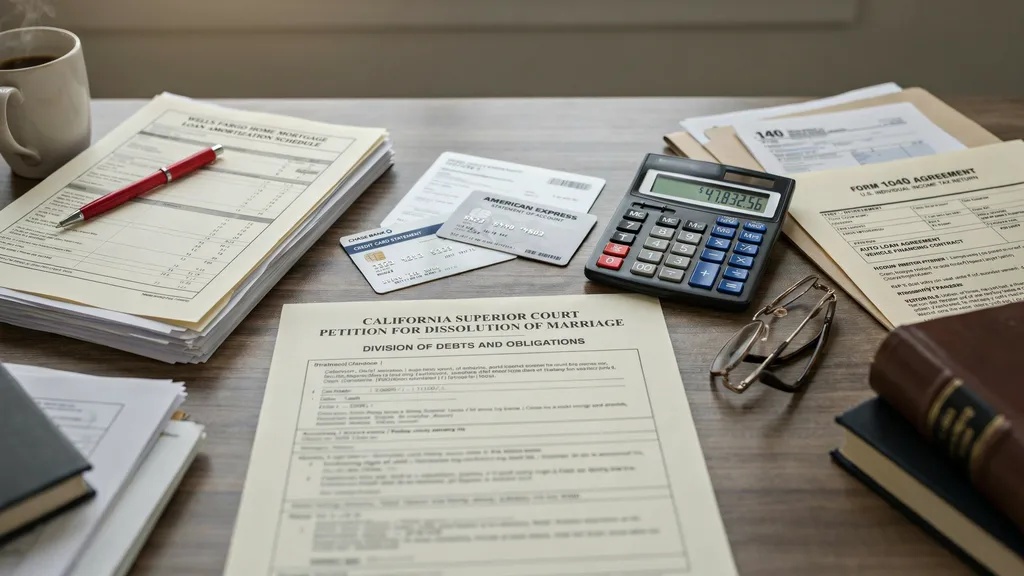
Debt gets split the same way assets do, based on when it was taken on.
Credit Card Debt
Credit card balances built up during the marriage are usually shared debt, even if only one spouse's name appears on the account.
The date of separation marks the cutoff for what counts as shared debt going forward.
Mortgages and Auto Loans
Loans tied to shared property, like a house or car, follow the same rule as other marital debt.
Whoever keeps the asset typically takes on the related loan payments after the divorce is finalized.
Student Loans
Student loan debt from before the marriage typically stays with the spouse who took it out.
If community funds were used to repay student loans, reimbursement issues may also arise depending on the circumstances.
Loans taken during the marriage may be treated differently depending on how the money was used and when it was borrowed.
Tax Debts and Other Obligations
Unpaid taxes from during the marriage are often treated as shared debt.
Couples should review joint tax filings closely before finalizing any settlement agreement.
Separate Property vs. Community Property

Not everything a couple owns gets split fifty-fifty in a divorce.
| Property Type | Typically Community | Typically Separate |
| Owned before marriage | No | Yes |
| Gift to one spouse | No | Yes |
| Inheritance to one spouse | No | Yes |
| Income earned during marriage | Yes | No |
| Assets bought during marriage | Yes | No |
| Commingled funds | Often disputed | Often disputed |
Mixed or Commingled Assets
Problems come up when separate and shared money get mixed together, such as depositing an inheritance into a joint account.
This is called commingling, and it can turn an asset partly or fully into shared property.
Sorting out what belongs to whom often requires asset tracing, a process that follows the paper trail back to its source.
Reimbursement Claims
If one spouse used separate funds to pay for shared property, like a mortgage, they may file a reimbursement claim under Family Code Section 2640 to recover some of that money.
Clear financial records make these claims much easier to prove in court.
Special Assets That Need Extra Care

Some property is harder to value and needs closer legal review.
Quasi-Community Property
Property a couple bought while living outside California may still count as community property once they move to the state.
This is called quasi-community property, and it follows the same division rules as property acquired in state.
Stock Options, RSUs, and Cryptocurrency
Stock options, restricted stock units, and cryptocurrency earned during the marriage count as community property.
These assets often need special valuation because their worth can change quickly between separation and the final settlement.
Intellectual Property and Royalties
Patents, copyrights, and royalty income from work created during the marriage may count as shared property, even if the income arrives after the divorce.
Courts sometimes assign these assets to one spouse with a cash offset to the other.
Trusts and High-Value Assets
Trusts and other high-value holdings require careful legal review.
How they get treated depends on how they were set up and funded, and whether a transmutation, a written change in an asset's character, ever took place.
Does 10 Years of Marriage Affect Spousal Support?

The ten-year mark changes support rules, even though property rules stay the same.
A marriage lasting ten years or more counts as a long-duration marriage in California.
Under Family Code Section 4336, courts keep indefinite jurisdiction over spousal support in these cases, so they do not set a fixed end date the way they might for a shorter marriage.
Property division still follows the strict fifty-fifty rule. Spousal support does not work that way. Judges weigh income, age, health, and earning ability when deciding how long support should last.
Ways to Divide Property Without Going to Court

Many couples settle property division on their own terms.
Marital Settlement Agreements
Couples can write their own agreement on how to split property and debt.
Once signed and approved by a judge, it becomes legally binding, as long as both sides made full financial disclosures first.
Mediation and Collaborative Divorce
A neutral mediator can help couples work out property division without a trial.
Collaborative divorce uses a similar approach, with lawyers guiding both sides toward an agreement outside the courtroom.
When Court Intervention Is Necessary
When couples cannot agree, or when one spouse hides assets, a judge may need to step in and decide the split directly.
This is also when tools like forensic accountants tend to get involved in the case.
Documents to Prepare Before Property Division
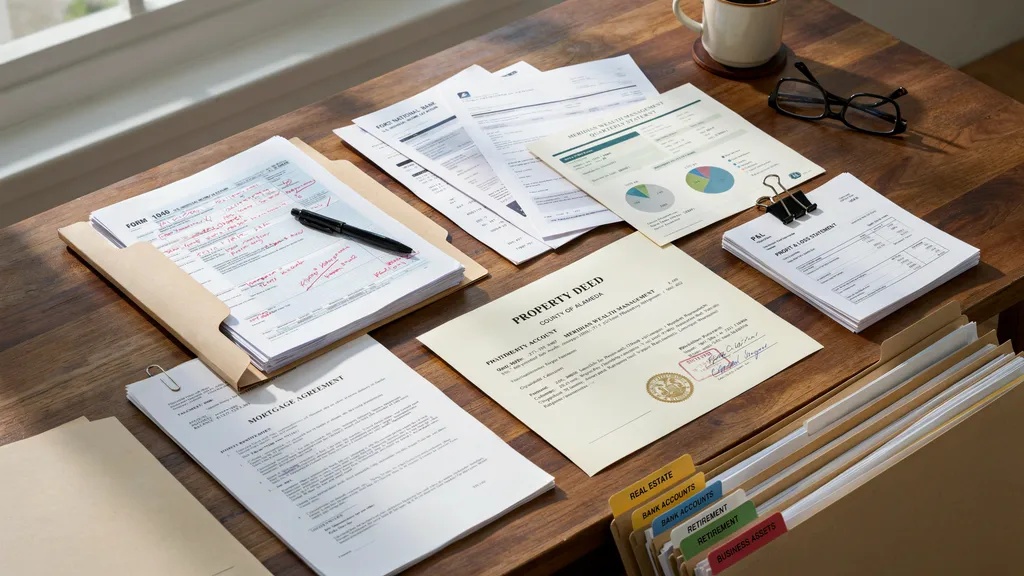
Having the right paperwork ready saves time and reduces stress.
Financial Statements
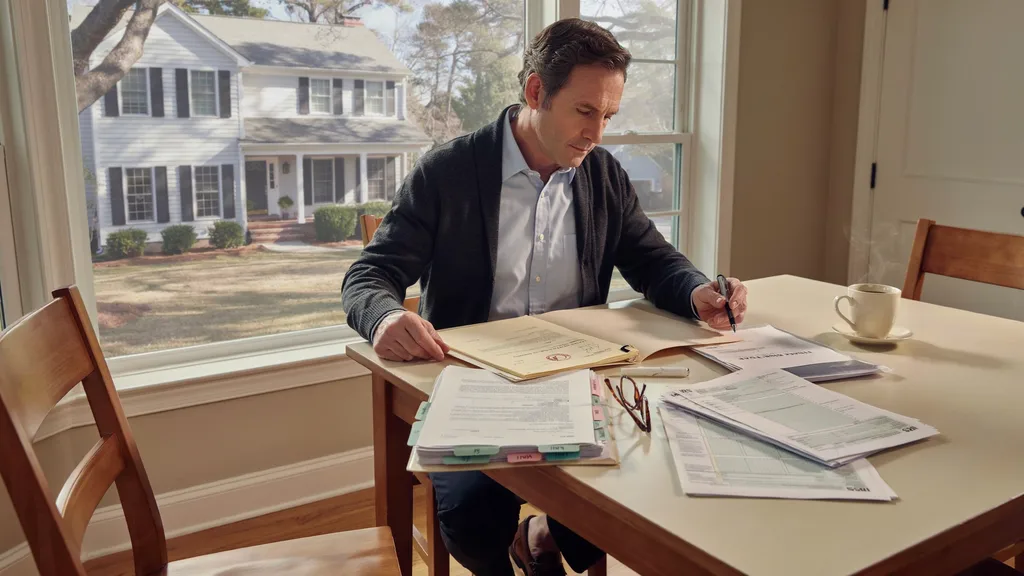
Bank statements, pay stubs, and tax returns give a clear picture of income and shared money during the marriage.
These documents also form the backbone of your PDOD.
Property Ownership Records
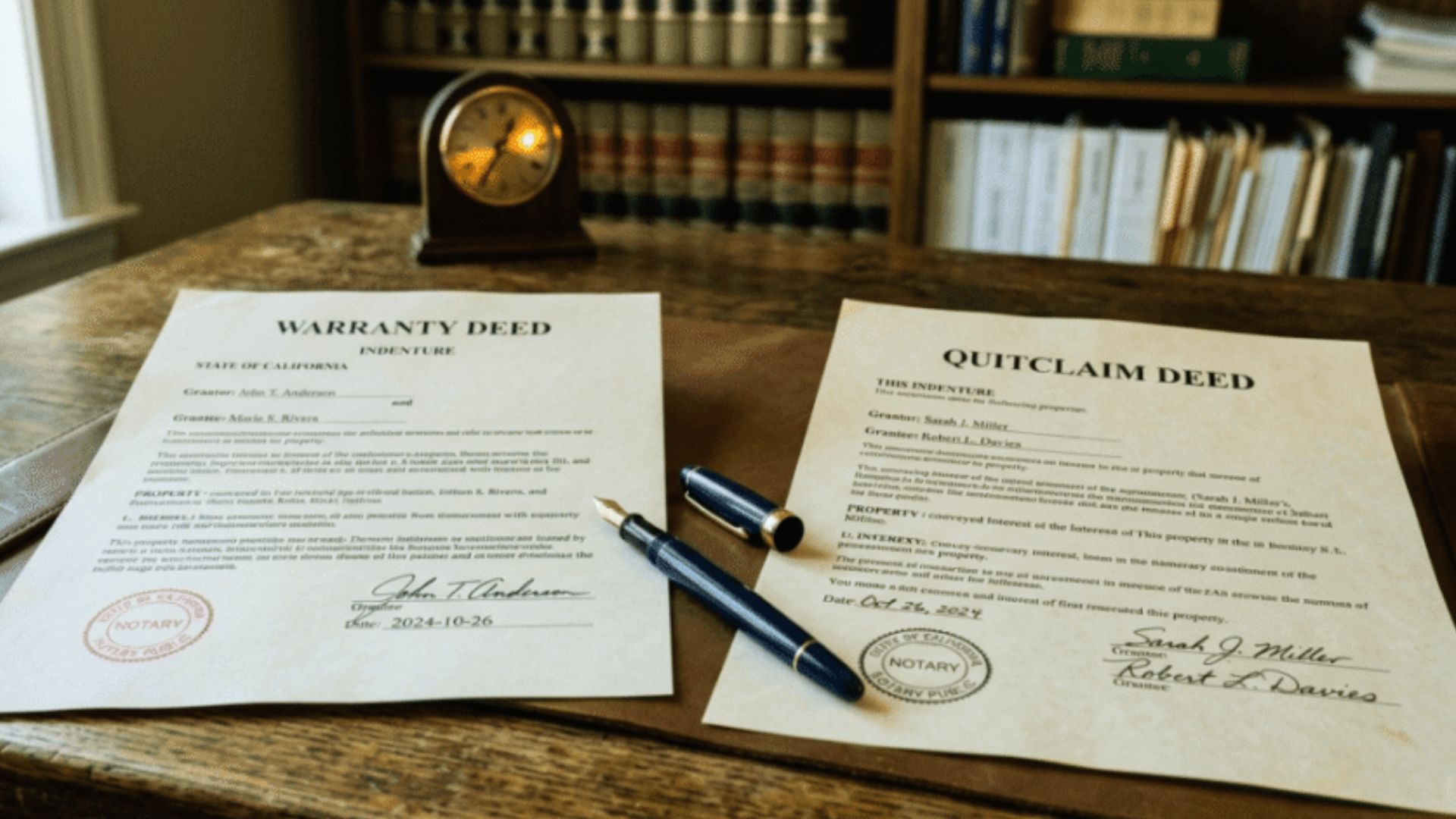
Deeds, titles, and purchase records help confirm who owns what and when each item was acquired during the marriage.
Retirement and Investment Documents
Statements for 401(k)s, pensions, and investment accounts are needed to value these funds and later split them correctly through a QDRO.
Business and Debt Records
Loan statements, credit card records, and business financials help settle who owes what and what a shared business is worth.
A forensic accountant may review these records in complex cases.
Tips to Protect Your Property Rights
Small steps early in the process can prevent bigger problems later.
- Keep separate property documented with receipts, titles, and account records
- Avoid mixing separate and community funds in shared accounts
- Gather financial records before filing so your PDOD is accurate from the start
- Get professional valuations for major assets like homes and businesses
- Understand the tax impact before agreeing to any settlement terms
Common Mistakes to Avoid
Simple errors can cost you money and time in court.
- Hiding assets or debts, which courts take seriously and can penalize
- Assuming everything splits fifty-fifty without reviewing separate property claims
- Overlooking retirement accounts and future benefits tied to them
- Ignoring the tax consequences of a proposed settlement
- Signing a settlement agreement without legal review first
Conclusion
Sorting out property after ten years of marriage takes patience, but the rules are more predictable than they seem. California splits community property equally no matter how long you were married, and the ten-year mark mainly changes spousal support.
Gather your records early, get professional valuations where needed, and lean on a family law attorney for anything unclear. If this guide helped, share it with someone working through the same questions about California community property law.
Frequently Asked Questions
Does being married 10 years change how property is split in California?
No. Property division always follows the fifty-fifty community property rule under Family Code Section 2550. The ten-year mark mainly affects spousal support.
What counts as community property in California?
Community property includes income, assets, and debts acquired during the marriage. This covers homes, retirement accounts, vehicles, and shared bank accounts.
Can one spouse keep the family home after a divorce?
Yes. One spouse can buy out the other's share, often through an equalization payment that balances the overall property split.
How does California treat retirement accounts in a divorce?
Retirement savings built during the marriage count as community property. A QDRO is usually needed to divide these accounts correctly.
Is spousal support guaranteed after a 10-year marriage?
Not guaranteed, but courts treat these as long-duration marriages under Family Code Section 4336 and may keep support open-ended.